

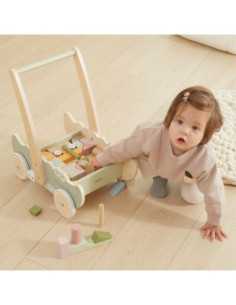
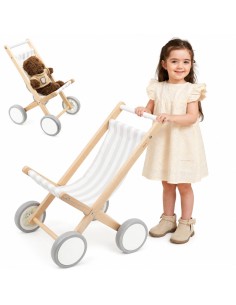

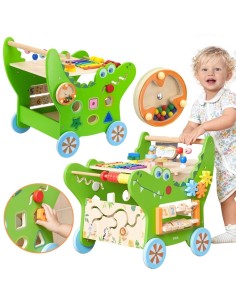
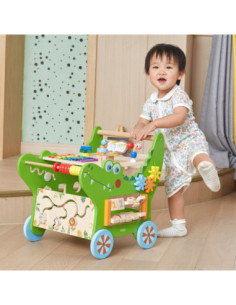
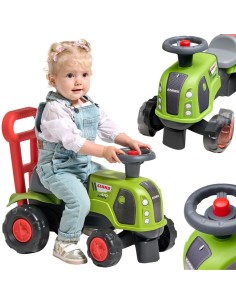
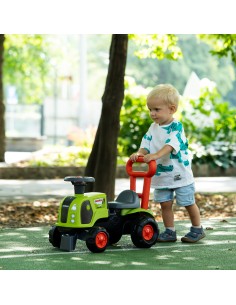
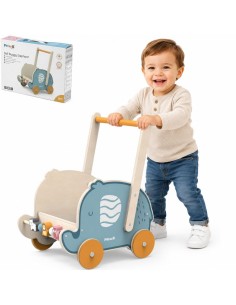
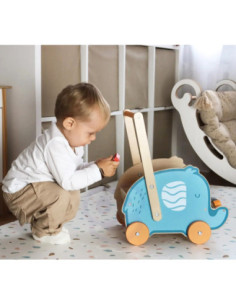
Walkers and pushers are a practical category for retailers who want products that combine movement, early development support and attractive play value. In a B2B toy assortment, these models are especially useful because they answer a clear customer need: helping toddlers take confident first steps while keeping them engaged with sensory and interactive features. For online stores, marketplace sellers and distributors, this means a category with strong commercial potential, easy presentation and a wide range of purchase motivations.
The assortment in this segment usually includes classic push toys, activity walkers, wooden walkers, multi-function pushers and models with music, lights, sorting elements or moving parts. Each of these versions appeals to a slightly different buyer profile. Some parents are looking for a stable aid for learning to walk, while others want a toy that keeps a child active for longer and supports coordination, balance and curiosity. This flexibility makes the category useful both for curated storefront collections and for broader e-commerce catalogs.
For a seller, this category is attractive because it is easy to explain and easy to position. The product purpose is immediately understandable, which shortens the buying decision and helps convert traffic into orders. Parents usually search for safety, stability, comfort and age-appropriate stimulation, so the most effective listings clearly present these benefits. Wholesale customers can build a reliable group of products that perform well across seasons, gift occasions and everyday purchases.
Walkers and pushers also work well as products with repeat demand. As children grow, buyers often look for a model that matches a new stage of development or a different style of play. This creates opportunities for stores to upsell from simpler push toys to richer activity walkers with more functions. In a retail environment, the category supports cross-selling with baby toys, developmental toys, wooden toys and activity items for toddlers.
When parents choose a walker or pusher, they usually compare a small set of practical features. Stability comes first, followed by handle comfort, wheel movement, construction quality and interactive elements. A well-designed product should support movement without feeling too light or too hard to control. For B2B partners, it is worth selecting models that can be described with specific advantages, because concrete product information sells better than general claims.
These features are especially important for stores that rely on clear product cards and comparison shopping. If the listing shows the differences between models in a simple way, the buyer can quickly choose the right version. This is particularly useful for online retailers working with a large catalog, where clarity directly affects conversion.
Walkers in this category are valued not only as toys, but also as tools that encourage mobility and confidence. They may be designed for children who are beginning to stand, cruising along furniture or taking their first steps with support. For many parents, the key advantage is that the toy provides an engaging reason to move. Instead of feeling like a simple training aid, it becomes part of everyday play.
Retailers can present these products as solutions for toddlers who need a stable and motivating companion during the walking stage. In descriptions and product cards, it helps to emphasize steady construction, smooth movement and balanced design. For households with limited space, compact models can also be attractive, since they combine several functions without taking too much room.
Pushers with interactive features are often the most eye-catching products in the category. They may include buttons, gears, sliders, shape sorters, spinning parts, sound effects or music. Such features extend play time and make the toy more useful after the child has mastered basic movement. That is important in the B2B context, because products that offer longer engagement are easier to position as value items rather than short-term purchases.
From a merchandising perspective, activity pushers are ideal for stores that want to show the educational and developmental side of toys without making the listing feel too technical. Buyers respond well to products that combine physical support with sensory play. For resellers, this means a strong opportunity to market the toy as both entertaining and developmental, which is one of the most effective combinations in the toddler segment.
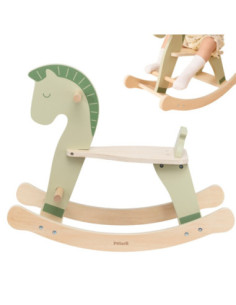
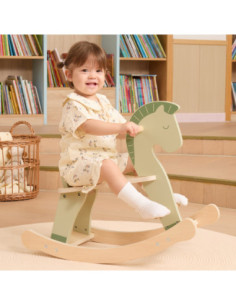
Material choice strongly influences how a walker or pusher is perceived. Wooden models often appeal to customers looking for a natural look, a calmer design and a more premium feel. Plastic versions can offer brighter colors, lighter weight and more interactive components. Mixed-material products may combine stability with richer functionality. For trade partners, it is useful to have a balanced portfolio so different customer preferences can be covered without overcomplicating the category.
Build quality matters especially in products for young children. Buyers look for sturdy construction, safe finishing, smooth edges and reliable components. These details can be highlighted in product descriptions and images, helping stores build trust. In wholesale sales, offering ready product descriptions and product photos makes it easier for partners to publish items quickly while maintaining a professional standard across channels.
In e-commerce, clear communication is often more important than long explanations. A shopper should immediately understand what the product does, who it is for and why it is worth buying. Strong product pages typically highlight the walking support function, the activity features and the age suitability. Retailers can also use comparison blocks, short bullet summaries and lifestyle images to improve readability.
This category is particularly suitable for multi-channel sales because the product logic is simple and the descriptions can be adapted easily to different platforms. On Allegro, Amazon, Erli or Empik Marketplace, concise and factual presentation works best. For partners using dropshipping or automated catalog management, walkers and pushers are a practical choice because the data can be synchronized efficiently across stock and price feeds.
For wholesalers and trade partners, the real advantage of this category is not only the product itself, but also the ease of operational handling. Ready descriptions, image sets and structured product data reduce the time needed to launch new listings. When XML integrations and automatic stock and price synchronization are available, a store can keep offers consistent across multiple sales channels without constant manual work.
This matters especially for businesses operating several storefronts or marketplace accounts at the same time. A walker or pusher can be published once and then managed centrally, which lowers the risk of mismatched data. As a result, partners can focus more on sales, promotion and assortment planning instead of repetitive technical tasks. That is a meaningful advantage in a category that often sells through impulse decisions and seasonal buying patterns.
Walkers and pushers fit naturally into several merchandising strategies. They can be grouped by function, material, color style or developmental stage. Some stores may prefer to show simple first-step models alongside richer activity variants, while others may create a broader toddler movement section. Either approach helps customers compare products and discover higher-value options.
For resellers, these distinctions help build clearer assortments and easier navigation. For distributors, they also support more efficient B2B communication with partners who want specific product types for their own target audiences.
Parents buying walkers and pushers usually want more than just a toy. They want reassurance that the product is safe, useful and suitable for a toddler’s stage of development. They also appreciate toys that look attractive in the home and are easy to introduce into everyday play. This gives sellers a clear direction: use product content to explain benefits in practical language and avoid vague promises.
Good listings should answer common customer questions such as how stable the product is, whether the wheels move smoothly, what activities are included and what age range is recommended. When this information is visible upfront, the store reduces hesitation and improves buyer confidence. For B2B partners, that means fewer abandoned carts and more consistent category performance.
Walkers and pushers are a strong fit for modern online retail because they combine broad appeal with relatively simple product logic. They are easy to photograph, easy to describe and easy to organize within a growing catalog. The category supports both entry-level products and more advanced versions, which is useful for stores that want to appeal to different price points without changing the core assortment structure.
For companies working with automated sales processes, this is a highly manageable category. The same product information can be reused across multiple platforms, while stock and price updates stay synchronized. That lowers operational friction and helps maintain a clean, professional offer in every channel. In practice, this is exactly the kind of category that benefits from a wholesaler providing ready materials and reliable integration support.
Walkers and pushers are a commercially practical category for toy shops, marketplace sellers and B2B partners who need products with clear purpose, strong parent appeal and easy online presentation. The assortment can include simple support models, interactive activity pushers and more premium versions, giving retailers the flexibility to build a balanced toddler segment. With stable products, attractive design and development-focused features, the category offers solid sales potential and a straightforward path to conversion.
For wholesale customers, the biggest advantage is scale with simplicity: ready descriptions, images, XML integration and synchronized data make it easier to launch and manage listings across multiple channels. Whether the goal is Allegro sales, Amazon expansion, Erli listings, Empik Marketplace presence or dropshipping support, walkers and pushers remain a reliable and practical part of a modern toy assortment.