

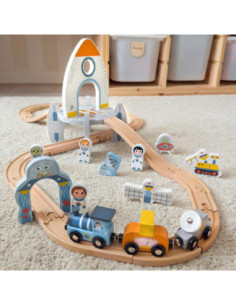
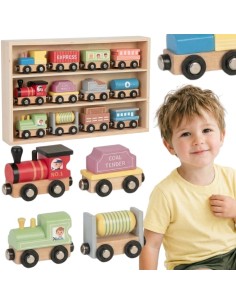
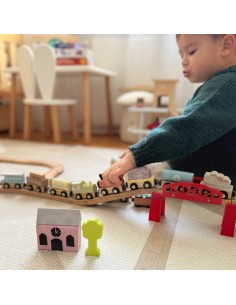
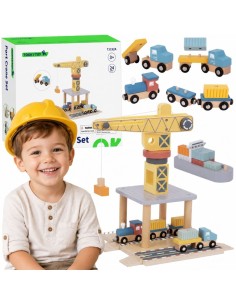

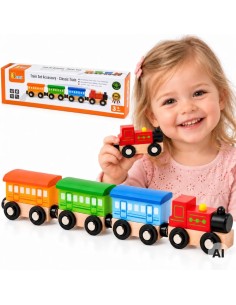

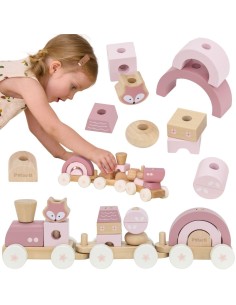
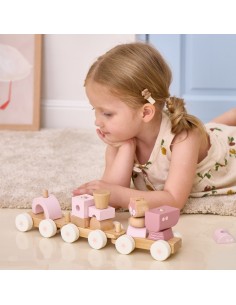
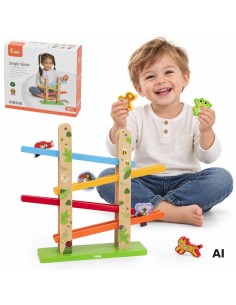
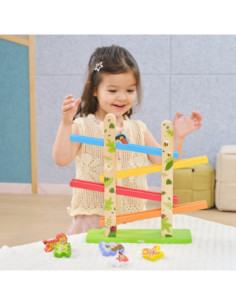


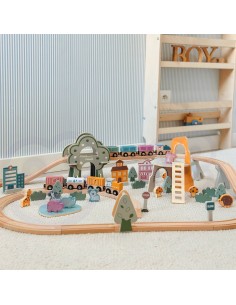
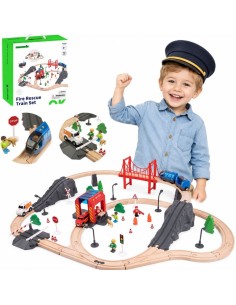
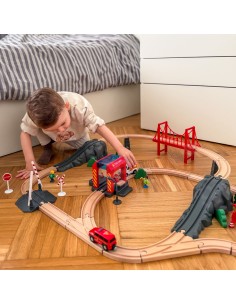
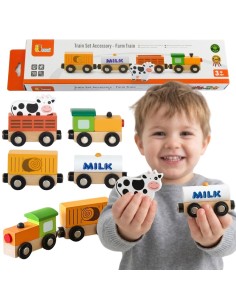

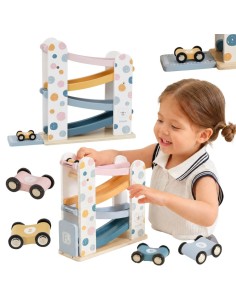
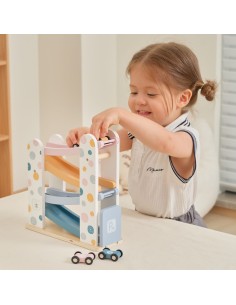


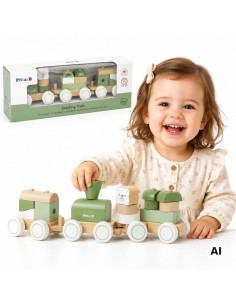
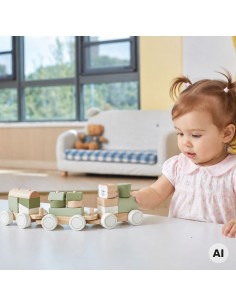
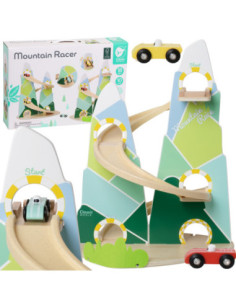
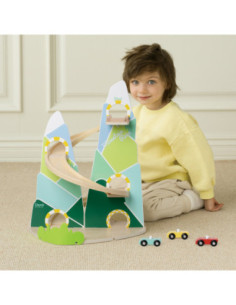
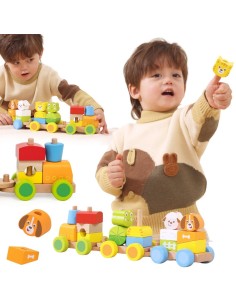
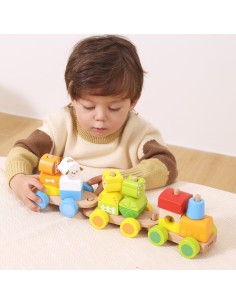
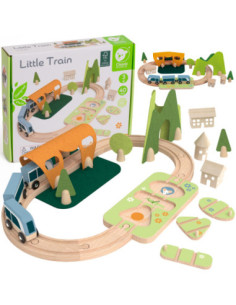
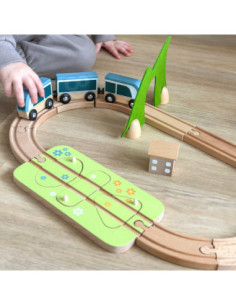
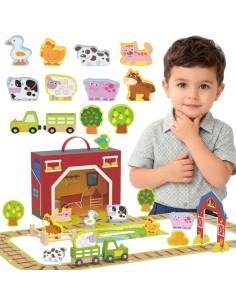


Trains and tracks are a strong, reliable category for B2B toy assortments because they combine immediate play value with clear upsell potential. A good train set does not end with the first purchase: children quickly want longer routes, extra curves, bridges, switches, stations, tunnels, and vehicles, while retailers benefit from a category that naturally supports repeat orders and accessory sales. For online stores, marketplaces, and wholesale partners, this makes trains and track systems a practical assortment with both emotional appeal and commercial longevity.
The core strength of this category is its flexibility. Simple starter sets are ideal for younger children and gift buyers, while more advanced layouts attract families looking for a more engaging, longer-lasting toy. Wooden railways, plastic track systems, battery-powered locomotives, magnetic connections, and modular route extensions each serve a different customer need. This variety helps sellers build a structured offer: basic sets for entry-level buyers, compatible expansions for returning customers, and themed accessories that increase average order value.
Trains and tracks are highly visible products that convert well online when the listing clearly shows what the customer gets. The package contents, number of track elements, compatibility, and possible route shapes matter as much as the visual design. A buyer can quickly understand the value of a product if the description explains whether it is a ready-to-play starter set, an expansion pack, or a more advanced system designed for larger layouts. That clarity reduces questions before purchase and supports a smoother sales process for resellers and marketplace sellers.
For B2B buyers, this category is attractive because it is easy to segment. Retailers can separate compact budget-friendly sets from larger premium layouts, then add expansions, accessories, and themed elements around them. This structure makes merchandising easier in an online store and also improves cross-selling on platforms such as Allegro, Amazon, Erli, and Empik Marketplace. When products are grouped by system, theme, or complexity, customers can build their basket step by step instead of treating the toy as a one-time purchase.
One of the biggest advantages of trains and tracks is the ability to create a layered offer. Starter sets introduce the toy and usually contain the most essential parts: a locomotive, a few wagons, and a basic route. Expansion products then keep the customer engaged by adding length, changing direction, or enabling more complex play. Track connectors, extra rails, turnouts, elevated sections, crossings, scenery elements, and station accessories all help extend the life of the original purchase.
This is especially useful for wholesalers and distributors because it creates repeated demand. A customer who already owns a basic set may come back later for more pieces, and a retailer that understands the compatibility of the range can confidently recommend follow-up products. In practice, that means better stock rotation and a stronger chance of building loyal buyers who return for additions rather than switching to another category.
Product families that share a similar connection system are particularly effective. When the assortment is coherent, stores can present a complete ecosystem instead of unrelated items. That makes it easier to create bundles, seasonal promotions, and gift suggestions. For trade partners, this can support better planning of stock levels and more efficient purchasing, because the assortment behaves like a system rather than a collection of isolated products.
In this category, product presentation matters as much as product design. Customers often compare trains and tracks based on several practical features: route length, ease of assembly, material quality, compatibility with other sets, number of pieces, motion type, and the presence of additional figures or scenery. Good descriptions make these differences obvious and help shoppers choose the right item faster.
For stores selling through multiple channels, consistency is essential. A well-prepared product listing should clearly show whether the set is wooden, plastic, battery-powered, manual, or part of a modular system. It should also explain whether the toy is suitable for independent play, shared family play, or as an add-on to an existing collection. When these details are visible in the product data, the offer becomes easier to publish across a web shop and marketplaces without rewriting every listing from scratch.
Ready product photos and structured descriptions are especially valuable in e-commerce because trains and tracks are visually driven products. A customer needs to see the route, the train, and the overall play concept. This lowers uncertainty and often improves conversion. For resellers and dropshipping partners, it also reduces the workload connected with content creation, which makes it easier to launch new products quickly and maintain a broader assortment.
From a wholesale perspective, trains and tracks are not only a toy category but also a merchandising tool. They help build an offer that can start with an entry-level product and grow through accessories and larger sets. This structure naturally supports margin management because accessory items often complement the main purchase without requiring a full replacement of the original set.
For B2B partners, another advantage is predictability. Train systems often follow a recognizable logic, so once a retailer understands one line, it becomes easier to expand the range with related items. This reduces assortment friction and can improve planning for seasonal peaks, such as holidays, birthdays, and gift campaigns. The category also performs well in online stores where product comparison, filtering, and category trees make it easy for customers to navigate between similar options.
Multi-channel sellers benefit from the category’s clear specifications. When stock and prices are synchronized through XML integrations or similar automation tools, products can move between a warehouse, a web shop, and marketplace listings with less manual work. That is particularly important for sellers active on Allegro, Amazon, Erli, or Empik Marketplace, where accurate availability and consistent product data directly affect sales performance. Automation helps reduce errors, protects service quality, and keeps the offer up to date across different channels.
A well-designed assortment should cover several customer groups. Younger children and gift buyers usually look for simple, easy-to-understand sets that can be used right away. Parents often value durable materials, safe connections, and a play pattern that keeps the child interested for longer than a single afternoon. More advanced buyers may look for larger layouts, richer scenery, or system compatibility that allows them to expand over time.
For retailers, the most effective range usually includes:
When these product types are combined logically, the category becomes easier to sell and easier to scale. Customers can start small and expand gradually, while stores can present a clear purchase path that encourages return visits. That is one of the reasons this category remains attractive for online sellers and distributors: it supports both first-time orders and repeat purchases.
Trains and tracks are well suited to dropshipping and reseller models because they are straightforward to describe, easy to photograph, and simple to compare within a structured catalog. When the product data is complete, sellers can publish faster and spend less time on individual content preparation. That is a significant advantage in competitive marketplaces where speed and consistency affect visibility.
For partners managing a larger assortment, ready product descriptions and images can significantly reduce operational effort. They help keep listings uniform across channels and make it easier to update stock levels, titles, and pricing rules. If a wholesaler provides synchronized data feeds, the retailer can maintain an accurate offer without constant manual intervention. This is especially valuable when selling multiple product families at once and needing to avoid duplicate work for each channel.
Another advantage is that train sets often support cross-selling. A buyer interested in one starter set may later add track extensions, scenery, or an upgraded train. This creates opportunities for follow-up orders and basket growth. Stores that present these relationships clearly can turn a single product page into a broader sales opportunity.
Customers generally want a toy that is engaging, easy to assemble, and worth returning to over time. They expect a route that is understandable at first glance, parts that fit together properly, and a train that adds motion and excitement. They also appreciate products that can be combined with other elements later, because that makes the toy feel more complete and more durable in terms of play value.
Retailers who communicate these benefits clearly can create stronger product pages and reduce hesitation during the buying process. When the offer explains compatibility, set size, build possibilities, and age suitability, it becomes easier for the customer to make a confident choice. That translates into better conversion and fewer pre-sales questions, which is especially helpful for marketplace sellers handling a high number of listings.
Trains and tracks work well in a wholesale toy assortment because they combine emotional appeal with practical business logic. The category encourages expansion, supports repeat purchases, and gives retailers a clear way to structure their offer from simple starter sets to more advanced layouts. It also fits well with the operational needs of modern B2B sellers who depend on accurate stock data, synchronized pricing, and efficient content management.
For online stores and trade partners, this means more than just offering a toy. It means building a category that can be sold across several channels, supported with ready descriptions and images, and expanded with complementary items over time. With the right assortment strategy, trains and tracks become a reliable part of a broader sales model that works for shop owners, marketplace sellers, resellers, and distributors alike.