


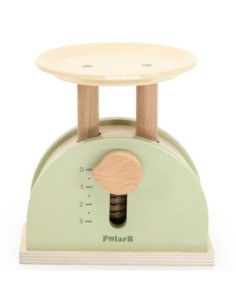

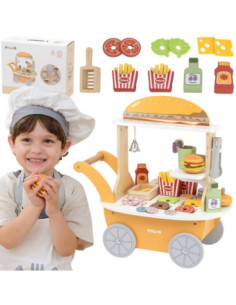
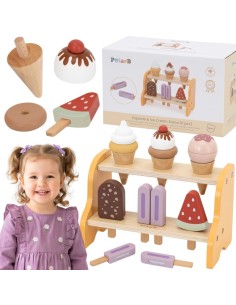
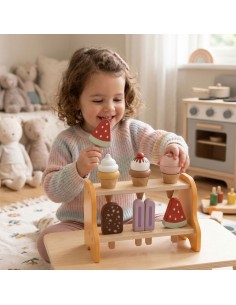
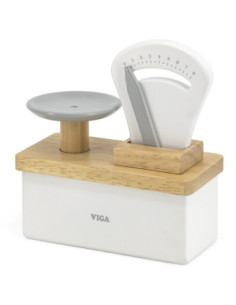

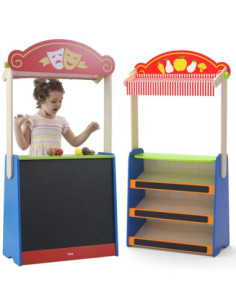
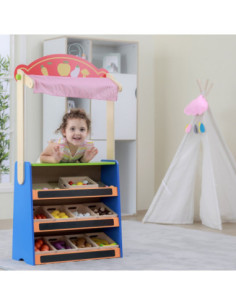


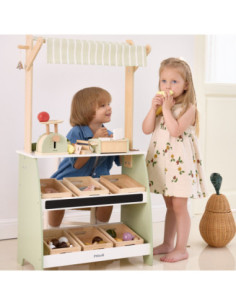


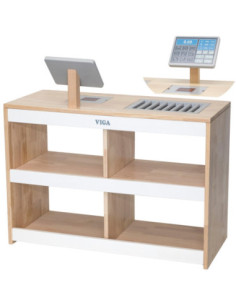

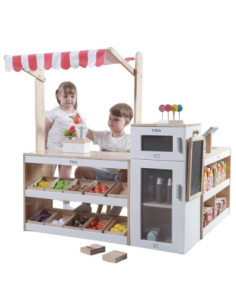

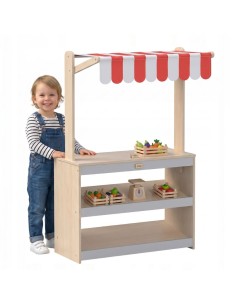


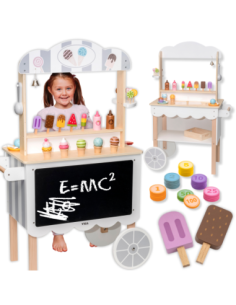
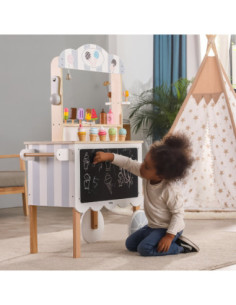
Shop and checkout toys are a dependable category for retailers who want products that combine role play, learning, and strong visual appeal. Children naturally gravitate toward pretend shopping scenarios because they can copy everyday situations, assign roles, count items, handle money, and create their own rules. For B2B partners, this means a category with clear sales arguments: educational value, repeated play value, and easy presentation in an online catalogue or marketplace listing.
In practice, products from this segment work well because they offer more than one type of play. A child may start by arranging goods on shelves, then move on to scanning items, accepting payments, or serving a customer at the counter. That flexibility makes the category attractive for parents and gift buyers, while also helping resellers build bundles and cross-sell complementary items. Sets that include a checkout, accessories, play money, baskets, shelves, and product pieces usually perform especially well because they create a complete play environment from the first use.
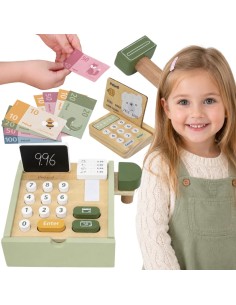
When selecting toys for your assortment, focus on durability, clear functionality, and a design that is easy to understand from product photos. Buyers often look for sets that look complete and intuitive: a visible till, realistic buttons, a stable stand, accessories that fit small hands, and elements that can be arranged in a tidy way. These details matter in B2B sales because they reduce hesitation, lower the number of pre-sale questions, and make the offer easier to publish across several channels at once.
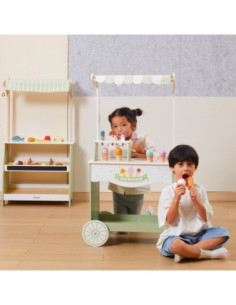
Imaginative retail play is one of the most universal children’s themes. It appears in homes, nurseries, playrooms, and gift purchases throughout the year. Children enjoy being a cashier, a customer, or a shop owner, and these roles naturally support social interaction. A toy shop or checkout set can keep several children engaged at once, which increases play time and makes the product feel more valuable to the end buyer.
From a wholesaler’s perspective, this is also a category with strong presentation potential. It is easy to show the product in action, easy to describe in a listing, and easy to position as both entertaining and developmental. That combination is useful when you sell to online stores, marketplace sellers, and dropshipping partners who need quick, clear, and conversion-oriented product content.
For many customers, the biggest advantage is that shop play feels familiar. Children already observe adults paying, packing groceries, and comparing items, so the game has a natural structure. This makes the category easy to explain in product descriptions and simple to promote in seasonal campaigns, birthday assortments, and gift-focused collections.
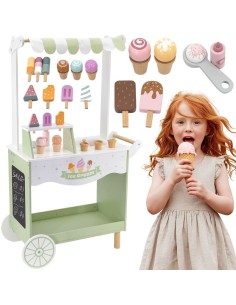
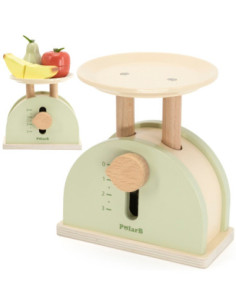
The core of the category usually includes toy shops, cash registers, checkout stands, and themed role-play sets. These products are especially effective when they are modular and easy to expand. A basic till can become a more complete scenario when paired with shelves, toy food, labels, shopping baskets, a scanner, or a payment terminal-style accessory. This makes it easier for store owners to build a layered assortment with different price points.
Smaller sets are useful for impulse purchases and lower basket values, while larger shop stations work well as gift items and higher-margin offers. A good retail mix often includes compact checkouts for quick entry-level sales and larger play shops for customers looking for a more complete experience. This approach helps you serve both budget-conscious shoppers and buyers searching for a standout present.
Attention to detail is important. Realistic sound functions, opening drawers, display spaces, pretend banknotes, barcode readers, and product labels all increase perceived value. At the same time, the product should remain practical for home use: stable enough for repeated play, simple enough to set up quickly, and safe enough for young children who will handle the pieces many times a day.
Shop and checkout toys are popular because they mix entertainment with practical learning. Children can count, compare quantities, sort products, recognise shapes and colours, and practise simple social interactions. They also learn about turn-taking, decision-making, and basic money concepts. For some families, this type of role play is especially appealing because it offers structured, engaging activity that can support development through repetition and imitation.
That educational angle is important in sales communication, but it should be presented naturally. Buyers usually respond best when they see the toy as an enjoyable play experience first and a developmental tool second. Good product content therefore highlights both sides: the fun of running a store and the value of practising everyday skills in a safe, playful setting.
This is also a category that can be adapted for different ages and needs. Simpler sets with large pieces and clear functions are suitable for younger children, while more detailed shops with accessories and interactive features appeal to older kids who want more control over the game. For wholesalers, that range makes the category easier to segment and easier to scale across multiple customer profiles.
For trade partners, this category is attractive because it can be built around several clear product types. Entry-level items may include standalone cash registers, scanners, and small checkout toys. Mid-range offers often include counters, shelves, play money, and accessory packs. Higher-value products usually combine several play functions into one complete shop unit. This tiered structure allows you to serve multiple price segments without changing the category theme.
Another benefit is repeatability. Once a customer has sold one shop set successfully, it is easier to add related products such as shopping baskets, pretend food, signage, or extra till accessories. That opens the door to cross-selling and bundled promotions. In an online catalogue, these items can be grouped into themed collections that support larger orders and improve average order value.
Retailers working with marketplace channels often prefer products that are easy to list, easy to compare, and easy to present in images. This category performs well in that environment because a shopper can instantly understand the use case. The product is visually self-explanatory, which helps with click-through rates and reduces friction in the buying process.
Online stores and marketplace sellers tend to prioritise clear product data, strong images, and consistent descriptions. Shop and checkout toys meet these needs particularly well when the offer includes ready-to-use assets and structured information. A well-prepared listing can show the full set, the main components, the size of the play area, and the kinds of role-play scenarios the toy supports.
For B2B partners, this matters because it shortens the time needed to launch new products. Ready product descriptions and images make it easier to publish new offers without building everything from scratch. If your business also works with XML integrations and automatic stock and price synchronization, this category becomes even more efficient to manage across multiple sales channels.
That is especially useful when you sell on Allegro, Amazon, Erli, or Empik Marketplace. Each platform has its own listing habits, but the core product story remains the same: role play, practicality, and good visual presentation. A category like this benefits from consistent naming, stable data, and easy-to-understand features that can be reused across channels.
Successful marketplace content should answer the customer’s main questions quickly. What is included? How does it work? Is it suitable for a gift? Does it look complete? Shop and checkout toys are straightforward to describe because the value proposition is obvious and easy to show in photos. A visible counter, clear accessories, and a realistic play setup can immediately communicate what the child will do with the product.
When product data is clean and synchronised, it is easier to maintain consistency between your store, marketplace listings, and dropshipping offers. That reduces errors, lowers manual work, and improves trust in the offer. It also helps protect the customer experience, especially when products are sold in many places at the same time.
For resellers, this kind of category is particularly useful during busy sales periods. Seasonal demand for gifts, educational toys, and home play products often rises quickly, and having a well-organised assortment with updated data can make a noticeable difference. A shop toy with a strong visual and clear purpose is easier to promote than many more complex products.
Shop and checkout toys fit well into dropshipping workflows because the category is easy to present, easy to describe, and easy to categorise. When a partner has access to current stock, synchronized pricing, and ready product information, the whole process becomes more predictable. That helps prevent overselling, listing errors, and unnecessary customer service issues.
Automation also saves time in catalogue maintenance. If the assortment is updated through XML integrations, product data can remain consistent across channels with far less manual editing. This is particularly valuable for stores that manage many categories at once and need reliable, scalable content processes. In practice, the category becomes not just a sales opportunity but also an operationally efficient one.
Because the toys are visually clear and familiar, they are also easier to re-market in bundles or promotional sets. A checkout can be paired with play money, a shop counter with accessories, or a full store set with add-on items. This gives distributors and online sellers more flexibility when building offers for different customer groups.
A well-balanced assortment in this category should include multiple play formats. Compact tills and scanners are useful as affordable add-ons. Mid-sized shop sets can serve as the main volume sellers. Larger themed play stores should be positioned as premium products with stronger visual appeal and higher perceived value. This structure makes the category suitable for both everyday sales and gift-driven campaigns.
It is also worth looking for products that support more than one activity. A toy that works as a cashier station, a pretend market stall, or a role-play counter has more sales potential than a single-purpose item. Flexibility is a strong feature because it extends the toy’s useful life and makes it easier for parents to justify the purchase.
In product communication, highlight the aspects that matter most to trade customers: clear functionality, strong visual presentation, simple handling, and broad appeal. Those are the factors that usually influence conversions in online retail more than technical complexity. The more naturally the toy demonstrates the shop experience, the easier it is to sell.
Categories with stable, easy-to-understand demand are important in wholesale because they simplify planning. Shop and checkout toys belong to that group. They are evergreen, seasonally useful, and suitable for many customer types. Parents buy them for home play, gift buyers choose them because they are familiar and engaging, and retailers appreciate that the products are easy to showcase.
For B2B customers, the combination of play value and commercial clarity is especially strong. You get a category that can be explained in a few seconds, supported with good visuals, and promoted across multiple channels without changing the core message. That consistency helps with brand building, campaign planning, and long-term catalogue growth.
It also helps that the category can be expanded without losing its identity. New variations in colour, accessory count, size, and design can refresh the offer while keeping the same customer intent. That makes it suitable for repeated purchasing by stores that want to keep their assortment current and attractive.
Shop and checkout toys are a reliable, visually strong category that combines imaginative play with practical learning and straightforward commercial appeal. They work well in online stores, marketplace listings, and dropshipping offers because they are easy to describe, easy to present, and easy to synchronise across channels. With ready images, product descriptions, XML integrations, and automatic stock and price synchronization, the category becomes even more efficient to manage at scale.
If you are building an assortment for B2B customers, this is a category worth treating as a core theme rather than a small side line. It supports entry-level products, mid-range sets, and premium play stations, giving you room to build bundles, increase basket size, and keep listings fresh. Most importantly, it offers something that is always in demand: a familiar, enjoyable play experience that children understand immediately and parents are happy to choose.