
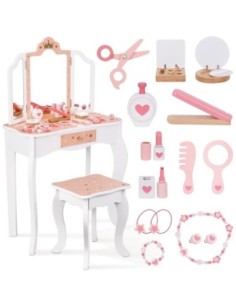
SKU: 58243
Equipment Elements is a category designed for B2B toy sales where completeness, compatibility and clear product presentation matter just as much as the item itself. It includes practical accessories, replacement parts and complementary components that help online stores, marketplace sellers and trade partners build fuller offers, create better bundles and keep assortments easier to manage. For wholesalers and resellers, these products are especially valuable because they support upselling, improve average order value and make it easier to respond to customers who are looking for a specific missing piece rather than a completely new set.
In multi-channel commerce, small accessory items often sell faster than larger products because they solve a clear need: a missing part, an upgrade, an addition to an existing set or a functional element that makes a toy more useful. That is why this category is important for sellers working with Allegro, Amazon, Erli or Empik Marketplace. Well described elements of equipment can be published quickly, linked to the right parent products and combined into logically structured listings that are easier for customers to understand. When product data is complete and consistent, the purchase journey becomes shorter and more effective.
Equipment elements are not only spare parts. In a B2B context they are often the products that make a standard assortment more attractive and more commercially flexible. They can serve as additions to a toy set, supporting pieces for role play, replacement items for frequently used products or components that allow a retailer to build a more complete bundle. This is especially useful when a store wants to offer both entry-level items and higher-value combinations without changing the whole core assortment.
For e-commerce sellers, the main advantage is the ability to extend the life of existing offers. When a customer already owns part of a set, a single matching element can be enough to generate a sale. When a store presents these items with clear compatibility information and practical photos, the customer is more likely to buy. That means more conversions, fewer abandoned baskets and better use of traffic already coming to the product pages.
For wholesalers and resellers, this category is important because it helps maintain continuity in the catalog. Many buyers do not want a new toy every time; they need one component, one accessory or one matching part that restores full functionality. Offering these products makes it possible to serve both end customers and business clients that manage a wider product range. It also improves stock rotation, since smaller components often support repeat ordering and cross-selling.
In a busy online store, these items are ideal for targeted merchandising. They can be linked to bestsellers, included in recommendation blocks or used as low-friction add-ons in the checkout flow. When a seller combines them with ready product descriptions and images, publication becomes faster and more consistent. That is a major advantage for teams handling many SKUs at once and needing to keep product pages up to date without excessive manual work.
With equipment elements, product presentation must answer a simple question quickly: what does this item do and what does it fit with? Buyers expect clarity, especially when they are searching for a specific part for a toy they already know. Good product descriptions should therefore explain the role of the element, its practical use, compatibility where relevant and the type of set or play pattern it supports. This reduces friction and helps the store present a professional, trustworthy assortment.
For marketplace sellers, this is particularly important. Listings need to be concise, informative and easy to scan, because customers compare many offers at once. Strong titles, clear images and structured descriptions make the difference between a product that is simply visible and one that actually sells. When the same content can be used across multiple channels, sellers save time and ensure that the offer looks consistent everywhere.
Equipment elements work especially well in stores that sell through several channels at the same time. A single product can be used as a supplementary offer in a webshop, as a standalone listing on Amazon or Allegro and as part of a broader set on another marketplace. The key is to keep the content and stock data synchronized so that the customer sees a reliable offer regardless of where they shop. That is where XML integrations and automatic stock and price synchronization become a practical business advantage.
When inventory changes are updated automatically, sellers can react faster to demand and avoid situations where the listing remains visible but the item is no longer available. This is important for smaller accessories, because they often move in response to active catalog traffic rather than seasonal campaigns. With the right automation in place, trade partners can focus on assortment planning and pricing strategy instead of repetitive manual updates.
Ready-made descriptions and images are also useful for catalog expansion. If a seller wants to add dozens of new elements to the store, the time saved on content creation can be substantial. This makes it easier to maintain a broader selection, test which items sell best and quickly expand the category with related pieces that support the main range.
Many equipment elements are chosen because they improve how a toy is used in practice. Some items support role play and make a scene feel more complete. Others serve as replacements for lost parts or worn accessories. There are also pieces that simply make the product easier to use, store or adapt for another set. In all these cases, the commercial value lies in solving a specific need instead of offering a broad general toy.
That specificity is a strength in B2B sales. A product with a clear function is easier to position in the catalog and easier to attach to the right audience. Parents looking for a replacement part, shop owners building themed bundles and distributors expanding their accessory range all benefit from content that explains the product in direct, practical language. This increases the chance that the item is found, understood and purchased.
In some assortments, these pieces can also support children who need toys for rehabilitation or developmental use, because the right accessory can help adapt a set to a specific activity. In such cases, clear product information is especially important. Sellers should present the item in a way that helps customers understand its use, while keeping the offer practical, respectful and easy to compare with similar products.
Trade partners often need products that are easy to distribute across many platforms without extra work. Equipment elements are well suited to this model because they are compact, often easy to ship and simple to describe when the data is prepared well. This makes them a good fit for dropshipping businesses, resellers and distributors who want to expand assortment depth without adding unnecessary operational complexity.
In a multi-channel environment, consistency is essential. The same product should have the same core data in the webshop, on marketplace listings and in any feed-based integrations. If the seller uses an automated system for stock and price updates, the risk of mismatch is much lower. As a result, the category becomes easier to scale, especially when supported by images, descriptions and structured product information that can be reused across sales channels.
For resellers and distributors, the most effective approach is to treat equipment elements as a strategic extension of the main toy assortment. Instead of viewing them as isolated small items, it is better to group them around use cases, compatibility and product families. This allows the business to create practical bundles, target specific customer needs and keep the catalog more intuitive for buyers.
The category is also useful for testing demand. Because these products are usually lower in value and easy to list, sellers can add them to the catalog quickly and observe which types perform best. The findings can then inform larger assortment decisions. If a particular accessory is popular, it may indicate demand for related products or for a complete version of the set it supports. In this way, the category helps drive smarter purchasing and more responsive sales planning.
When the offer is built around clear logic, customers can move naturally from one product to the next. A buyer who enters the store looking for one part may discover a complementary accessory, a more complete set or a related product family. This creates stronger basket-building potential without forcing a pushy sales approach.
The best-performing equipment elements usually share a few common traits. They are practical, clearly described and linked to a real use case. They fit into larger product stories and make it easier for the buyer to understand the benefit. From a wholesale perspective, that means the product can be marketed not only by its physical features, but also by the role it plays in the customer’s sales process.
For example, a compatible component can help complete a set, a replacement part can rescue a purchase that would otherwise feel incomplete, and a simple add-on can increase average order value. Each of these uses supports revenue in a slightly different way, but all rely on the same principle: the more useful and understandable the item is, the easier it is to sell.
Equipment Elements is a category that helps B2B toy sellers build more complete, flexible and commercially effective offers. It supports cross-selling, replacement sales, bundle creation and better product presentation across webshops and marketplaces. For online stores, Allegro and Amazon sellers, dropshipping partners and resellers, these products provide a practical way to increase catalog value without increasing complexity.
With well prepared descriptions, ready images and synchronized stock and price data, this category becomes easier to scale and easier to manage. It fits naturally into multi-channel sales and gives trade partners a reliable way to expand assortment depth. In short, it is a useful category for turning small parts and accessories into stronger sales opportunities.