
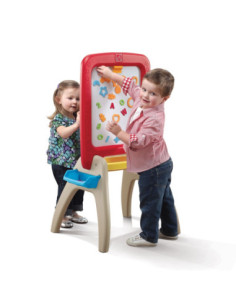
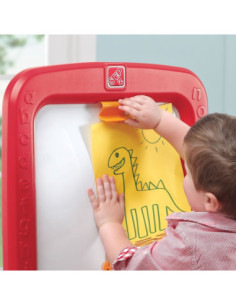
Boards are a versatile and highly attractive category for B2B toy retailers because they combine play, learning and visual appeal in one product line. In an online store, they are easy to present, easy to understand and easy to match with different customer needs, from first educational activities to more engaging at-home learning tools. For wholesalers and marketplace sellers, this means a category that can support steady demand, clear product presentation and strong cross-selling potential with accessories and themed sets.
In practice, boards work well because they offer a simple concept with many possible uses. Children can draw, write, match, sort, observe, follow tasks and repeat activities without frustration. Parents and caregivers appreciate products that encourage concentration, creativity and manual skills while still feeling like play. For B2B partners, this is a major advantage: the product is easy to explain in listings, performs well in visual channels and can be adapted to a broad age range depending on the model, set composition and level of educational challenge.
Boards are not limited to one form of play. They can support drawing, writing practice, magnetic activities, pattern recognition, early learning, sensory engagement and simple educational exercises. This flexibility makes them ideal for stores that want a category with both everyday utility and strong gift potential. They are also a good fit for seasonal campaigns, especially back-to-school periods, birthday assortments and gift collections for children who enjoy interactive learning products.
From a sales perspective, boards are valuable because the customer can immediately understand the purpose of the product. A clear product image, a visible set of accessories and a short functional description are often enough to move the buyer closer to purchase. That is particularly useful on Allegro, Amazon, Erli and Empik Marketplace, where concise communication and well-structured presentation influence conversion. In those channels, a category like this can perform well when listings clearly show what is included, how the item is used and what developmental benefit it brings.
In a B2B toy offer, boards can be divided into several practical subgroups. This makes it easier for stores to build a logical assortment, create bundles and expand the category with related products. The variety also helps resellers target different customer expectations without having to search for an entirely separate product line.
This diversity allows a wholesaler to support multiple retail strategies at once. Some partners will want simple, low-entry products for fast-moving sales, while others will prefer richer sets that look more premium and can be positioned as gift items. A broad board category makes it easier to serve both types of customers.
One of the biggest strengths of boards is that they can support development in a way that feels natural to the child. Repeated drawing, tracing, matching and arranging help build hand-eye coordination, fine motor control, visual perception and concentration. At the same time, they do not feel like a formal lesson. That balance is especially important for parents who are looking for toys that are engaging but still educational.
Boards also work well for children who benefit from calm, structured and repeatable activity. Because many of these products allow the child to try again, correct mistakes and perform tasks at their own pace, they can be useful in home learning routines and in settings where gentle support is important. This may include children who need extra encouragement in sensory or developmental areas, since the product format often provides clear visual cues, predictable actions and a reassuring sense of progress.
For retailers, this means the category can be described not only as entertainment but also as a practical educational tool. That gives product pages more depth and makes them more persuasive to buyers who compare several similar offers before making a decision.
Boards are one of those categories that translate very well into online sales. The reason is simple: the product is usually easy to show, easy to understand and easy to evaluate visually. A customer does not need a long explanation to grasp the basic function, but a well-written listing can still highlight the features that justify a purchase. That combination is ideal for e-commerce stores, especially those that depend on speed, clarity and efficient publishing.
For shops working with XML integrations and automatic stock and price synchronization, boards are also convenient because the assortment can be updated quickly across many channels. This is particularly valuable when you manage own-store listings and marketplace offers at the same time. If an item is available in several variants or set versions, the ability to keep prices and stock levels aligned helps reduce overselling and customer complaints.
In dropshipping models, the category is equally practical. The product is straightforward to present, and ready product descriptions and images make it easier to publish complete offers without additional content production. That saves time, supports faster expansion and helps partners maintain a consistent standard across their catalogues.
A strong category page or product listing should answer a few simple questions immediately: what is the product, what can the child do with it, and what is included in the set. In board categories, those details matter because they shape the buyer’s expectations. The clearer the communication, the easier it is to sell both the basic item and more advanced variants.
Store owners should focus on practical benefits rather than abstract claims. For example, instead of only saying that a board is educational, it is better to explain that it supports repeated practice, helps with concentration, encourages creativity or can be used as part of a daily learning routine. This makes the offer more concrete and more useful to parents, educators and gift buyers.
These details reduce uncertainty and help customers make a quicker decision. In B2B sales, that matters because partners often want content that can be used immediately across multiple platforms without heavy editing.
Boards are especially useful for partners who need products with broad appeal and manageable content requirements. They can be grouped by age, theme, learning function or accessory type, which makes merchandising simple. This category also supports upselling: a basic board can be complemented with markers, extra magnetic elements or themed educational add-ons.
For distributors and resellers, the category offers a nice balance between visual clarity and functional variety. It is easy to include in a back-to-school collection, an educational toy section or a gift-oriented assortment. Because the products are intuitive, they can also be used in multi-category merchandising alongside creative toys, learning games and sensory-focused items.
Another advantage is that boards are often easy to photograph in a way that immediately communicates value. That matters on marketplaces and in online stores, where visual presentation strongly influences click-through rate. A good image, a compact description and a clear list of benefits can do a lot of work for the seller.
When a wholesaler supports multi-channel commerce, boards become even more attractive. Their simple structure makes them suitable for different listing formats, from short marketplace titles to richer category descriptions in an online store. They are also a good fit for platforms where shoppers compare offers quickly and expect useful, item-specific information.
On Allegro and Amazon, buyers often scan for product type, features and included components. On Erli and Empik Marketplace, the quality of presentation and clear audience targeting can help distinguish one offer from another. Because boards are visually understandable, a retailer can use the same product logic across several channels while still adapting the wording to each platform’s style.
This is where operational support becomes important. Ready descriptions, ready images and synchronized product data help partners publish faster and keep their catalogues accurate. For a busy B2B seller, that means more time for assortment planning, promotion and customer support, and less time spent on manual updates.
A good wholesale catalogue needs categories that are easy to sell, easy to explain and easy to maintain. Boards fit that profile very well. They are broad enough to cover different customer needs, but specific enough to remain understandable. They can be inexpensive entry products or more feature-rich sets, depending on the design and content.
They also support repeat ordering. Retailers often return to categories that perform well visually and commercially, especially when the products are simple to list and can be refreshed with new variants. Boards can therefore become a stable part of an assortment strategy, not just a temporary seasonal item.
For B2B partners, this is important because it improves planning. If a category consistently attracts attention, supports educational value and fits multiple sales channels, it becomes easier to build campaigns, maintain stock rotation and forecast demand.
Boards are a category that combines learning, play and strong commercial usability. They are simple to present, versatile in use and suitable for a wide range of children’s needs. For online stores and resellers, they offer a chance to build a clear, attractive and highly functional assortment that works well in both direct retail and marketplace environments.
With XML integration, automatic price and stock synchronization, ready descriptions and images, and support for dropshipping and multi-channel selling, this category can be published efficiently and maintained with less effort. That makes it particularly valuable for partners who want products that are not only attractive to customers but also practical from an operational point of view.
If you are expanding an educational toy offer, boards are a reliable category to include. They help present learning as play, support repeat purchases through accessory sales and fit the expectations of modern e-commerce customers who want clear benefits and easy purchasing decisions.