
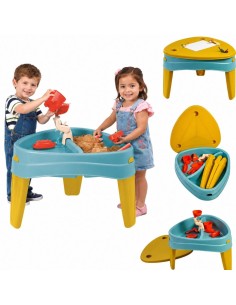
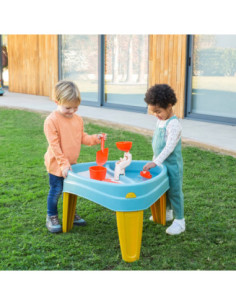
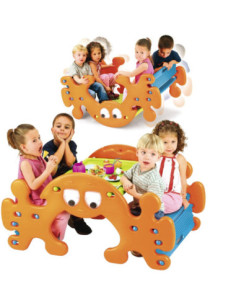
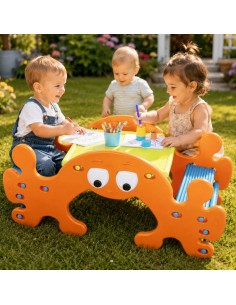
Children’s tables are among the most practical pieces of furniture in a toy retailer’s assortment. They support everyday play, encourage creativity and help organise a child’s space, which makes them a strong category for both online stores and B2B partners. In a well-built offer, tables are easy to position as products that combine functionality, attractive presentation and steady demand throughout the year. They work well as standalone items, but they also perform especially well in bundled sales, where a customer looks for a complete play or learning corner rather than a single item.
For wholesalers and resellers, this category brings a clear advantage: it addresses real buying needs. Parents, gift shoppers, early years institutions and marketplace customers all look for durable, easy-to-understand products that fit into daily routines. A children’s table can serve as a place for drawing, building, crafts, board games, puzzle solving, sensory activities or simple meal and snack moments in a play area. That versatility makes it easier to write effective product pages and to offer variants that appeal to different customer segments without changing the core category logic.
The strongest sales argument for children’s tables is their flexibility. In a home setting, they become a dedicated spot for creative play, independent tasks and quiet time. In nurseries, preschools and childcare spaces, they support small-group activities and help define a clear, child-friendly zone. For B2B buyers, this means one category can serve multiple channel strategies: retail, marketplace listings, dropshipping offers and institutional supply. A table that looks good in a child’s room can also fit into a reading nook, play corner or activity area in a professional setting.
When you present this category to your customers, it helps to emphasise everyday usability. Buyers often want something that is not only visually appealing but also easy to place in an existing room layout. Compact models suit smaller flats and tight play corners, while larger versions are better for shared rooms or activity spaces. That range gives store owners room for cross-selling and lets them build a broader assortment around age, room size and intended use.
Children’s tables are not just decorative furniture. They create a stable surface for activities that keep children engaged for longer periods and support fine motor development. Drawing, colouring, modelling, sorting pieces, assembling building sets and doing craft work all become easier when a child has a dedicated place to sit and work. In product descriptions, this is one of the clearest value points: the table helps turn spontaneous play into a more organised, repeatable activity.
From a trade perspective, this also improves conversion. Customers understand quickly what the product does and why it is useful. That clarity reduces hesitation at the purchasing stage, especially in online channels where the buyer cannot physically inspect the product. Clear sizing, intended use and feature highlights are especially helpful on marketplaces such as Allegro, Amazon, Erli and Empik Marketplace, where customers compare offers side by side and expect concise, structured information.
In this category, the most important product qualities are usually stability, practical dimensions, easy maintenance and attractive design. Buyers want a table that feels safe and functional, but also one that matches a child-friendly interior. A good assortment may include simple round or square models, themed designs, sets with matching chairs, and versions adapted to different age groups. The more clearly these differences are presented, the easier it becomes for a reseller to build a convincing offer.
Materials and finish also matter in a commercial listing. Customers value surfaces that are easy to clean after art activities, construction play or snack time. A table that can handle daily use is easier to promote as a long-term purchase rather than a one-off novelty. For online shops, this is important because it supports stronger product positioning and better repeatability in search results, recommendations and promotional campaigns.
For B2B partners, children’s tables are attractive because they can be presented in multiple ways. They can appear as part of a room furnishing offer, a creative play zone, a preschool equipment range or a gift-focused selection. This flexibility helps increase average basket value and opens room for add-on products such as chairs, organisers, art supplies, puzzles, building sets or educational games. A well-described table often becomes the anchor item that leads to several additional purchases.
In multichannel sales, speed and consistency are essential. That is why product data quality matters so much. Stores using XML integrations, automated stock and price synchronisation and ready-made product descriptions can publish this category faster and with fewer manual corrections. The result is a more reliable offer across e-commerce shops, marketplace accounts and dropshipping flows. When stock levels and prices stay aligned, the risk of cancellations drops and customer trust improves.
Wholesale buyers often want products that are easy to explain, easy to package into offers and easy to refresh seasonally. Children’s tables match that requirement well because they can be promoted all year round, not only during peak gift periods. They are relevant for birthdays, back-to-school promotions, room refresh campaigns, holiday buying and nursery equipment orders. This makes them a stable part of a broader category strategy rather than a niche accessory.
They also work well in curated sets. A table can be paired with chairs for a complete activity zone, or with creative and educational products that make the listing more attractive. For marketplaces, that can mean stronger visual storytelling and a clearer reason to buy. For independent online stores, it can mean better merchandising and a more coherent product page structure. In both cases, the outcome is the same: a category that is easy to browse and easy to sell.
Buyers typically pay attention to a few practical questions. They want to know whether the table fits the child’s age, whether it matches the available space, how easy it is to maintain and whether it feels stable during everyday use. They also want reassurance that the product is suitable for the type of play they have in mind. A strong description should answer these questions directly and help the customer imagine the table in use, not just as a product on a white background.
That is why well-prepared category content is valuable for resellers. It gives the customer a clearer idea of how the table supports daily routines, creative play and shared activities. It also helps the seller reduce pre-sale questions and improve the quality of the shopping experience. In multichannel environments, this can translate into faster decision-making and better performance across channels.
Children’s tables are easy to photograph, easy to describe and easy to sort into variants. This makes them especially suitable for online retail and marketplace listings, where the product page has to do most of the selling. A strong offer includes not only a visual presentation but also clear information about use case, size and practical advantages. That is why ready product descriptions and ready images are so valuable for sellers who manage large catalogues.
For marketplace sellers, one of the biggest operational advantages is synchronisation. When prices and stock levels are updated automatically, the offer stays accurate without constant manual checking. This is particularly useful for Allegro, Amazon, Erli and Empik Marketplace, where availability and listing quality affect both visibility and customer satisfaction. With the right setup, children’s tables become a manageable category that supports fast publication and scalable sales.
Although this category is not strongly seasonal, it still benefits from periodic peaks. Back-to-school buying, birthday shopping, holiday gift preparation and room reorganisation all create additional demand. In B2B sales, that means the product can be promoted in several different campaigns without changing its core positioning. A table that works as a gift can also be sold as a practical household item, which gives the category a wider commercial base.
Different customer types will focus on different benefits. Parents often want functionality and safety. Retailers want easy listing and clear product appeal. Distributors want stable rotation and assortment depth. Dropshipping partners want accurate stock data and quick order processing. A good category description should support all of these needs by showing how the product fits into everyday use, multi-channel distribution and practical sales planning.
To increase order value, children’s tables should be presented alongside complementary items that naturally extend the use of the product. Matching chairs, art materials, building toys, learning games, organisers and soft play accessories can all create a more complete offer. This is especially useful for online stores that want to improve cross-selling without adding unnecessary complexity. When the customer sees a ready-made activity corner, the purchase decision becomes simpler.
For wholesalers, this also supports catalogue efficiency. One category can serve several different merchandising concepts, from compact home play to classroom-inspired activity zones. That gives trade partners more flexibility and allows them to tailor the same core product to different audiences. It is a practical way to grow sales while keeping the assortment easy to manage.
In today’s toy wholesale environment, product quality is only part of the equation. Sellers also need reliable operational support. XML feeds, automated synchronisation, consistent product data and ready-made assets help shorten the time between receiving stock and listing it online. For companies selling across multiple channels, this can make a meaningful difference in speed, accuracy and overall efficiency.
Children’s tables benefit from this kind of setup because they are visually understandable and easy to standardise across channels. Once the product data is well prepared, it can be reused in an online store, on a marketplace listing or in a dropshipping catalogue with minimal adjustment. That makes the category suitable for businesses that want to grow without increasing manual workload at the same pace.
Children’s tables combine everyday usefulness, broad customer appeal and strong merchandising potential. They support creative play, learning through activity and organisation of space, while also giving sellers a product that is easy to present across online shops, marketplaces and B2B channels. With the right assortment, this category can become a reliable part of a catalogue that sells consistently and complements many other toy and nursery products.
For trade partners, the main advantages are clear: simple product logic, good cross-sell opportunities, wide usability and strong fit with modern sales processes. When combined with XML integration, stock and price synchronisation, ready product descriptions and images, the category becomes even easier to manage and scale. That is why children’s tables remain a smart addition to a professional toy wholesale assortment.